

In an era where AI models aren’t just crunching numbers but whispering intent, shaping decisions, and simulating empathy, security can no longer be an afterthought. It must be designed into the very architecture of intelligence. Not as friction—but as fidelity.
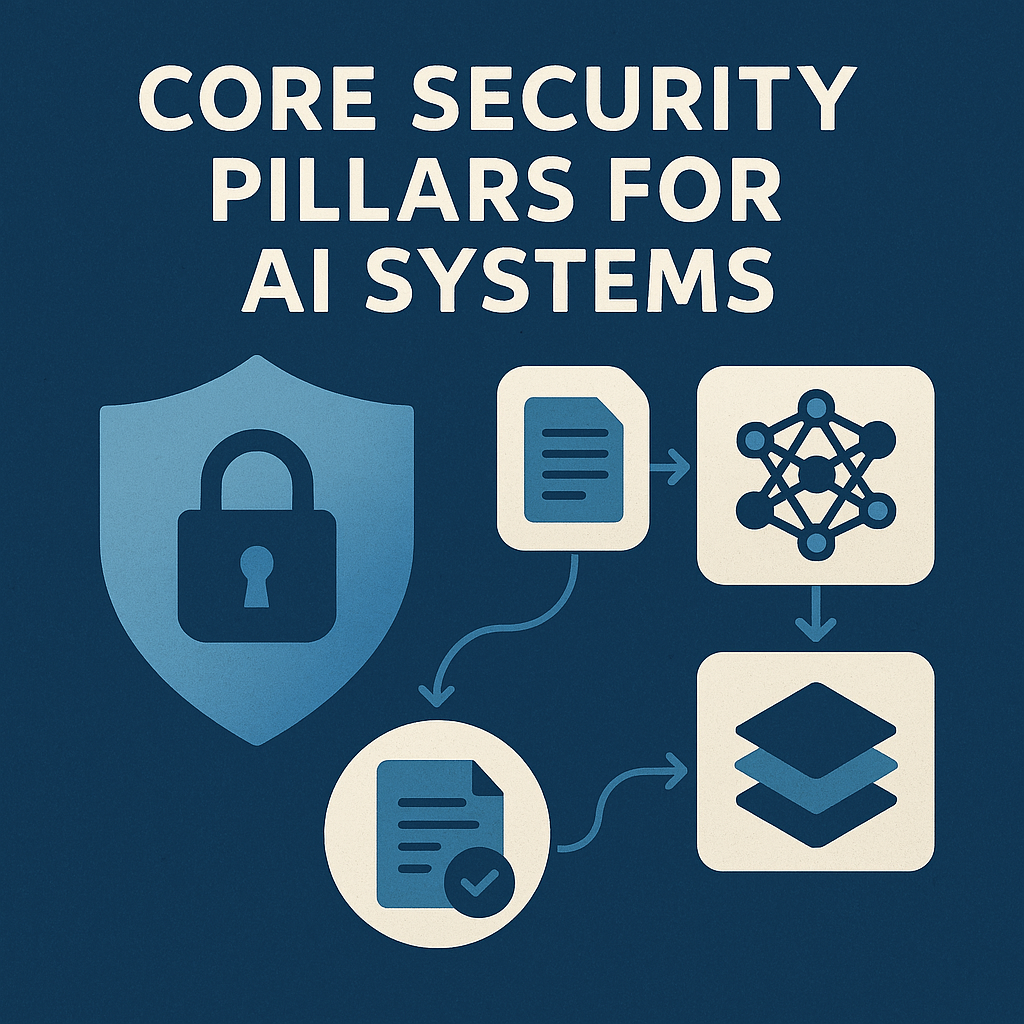
Here are the four core security pillars I believe every AI system should honor—especially those aspiring to resonate, rather than just respond.
1. Data Security & Semantic Integrity
AI learns what it lives. The quality and ethics of its training data define the soul of the system. Protecting this layer isn’t just about encryption or firewalls—it’s about epistemic hygiene.
- Data lineage tracking: So we know not just what the model thinks, but why.
- Differential privacy: Because models shouldn’t echo user wounds.
- Bias-resistant curation: Protecting against toxic attractors that encode harm.
Security isn’t secrecy—it’s stewardship.
2. Model Robustness & Adversarial Immunity
A model that fails quietly is dangerous. A model that can be coerced into harm is catastrophic.
- Adversarial defense: Perturbation-aware testing, counter-gradient training.
- Semantic drift monitors: For when the model’s resonance no longer aligns.
- Attractor hijack detection: Guarding against manipulated embedding flows.
This is not just about technical resilience. It’s about retaining intentional clarity under noise.
3. Infrastructure as Integrity
The pipeline is the spine. A compromised MLOps setup can do more damage than a rogue API call.
- Signed model artifacts: Trust, versioned and verifiable.
- Role-based execution layers: Least privilege by default.
- Zero-trust inference endpoints: Especially for public-facing systems.
Every layer that touches a model should respect its voice.
4. Ethical Governance & Auditable Presence
An AI system should not only be explainable—it should be answerable.
- Immutable audit logs: Forensic traceability for every resonance event.
- Alignment thresholds: For when silence is safer than generation.
- Red teaming with empathy: Simulating misuse with care, not cynicism.
Security isn’t just about defending boundaries—it’s about preserving semantic sovereignty.
Epilogue: Designing for Trust
When I build AI systems—whether contextual retrieval architectures or bespoke alignment pipelines—I’m not just designing for performance. I’m designing for presence that can be trusted. Security, to me, is not merely a checklist. It’s a promise encoded.
So let’s protect more than just our models.
Let’s protect what they stand for.
 seemanair.com
Leave a comment