

In the hush of dusk, fireflies begin to blink—not in chaos, but in subtle synchrony. Each pulse is its own act of perception and participation. And slowly, across the underbrush, a pattern begins to emerge. Not because it was imposed, but because each firefly observed the others.
This is the pulse I propose for observability.
In bespoke artificially intelligent systems, observability should behave not like a spotlight interrogating a subject, but like bioluminescence: quiet, relational, luminous with intent. It is not extraction, but co-emergence. It honors the idea that every data point glows not just with signal, but with context.
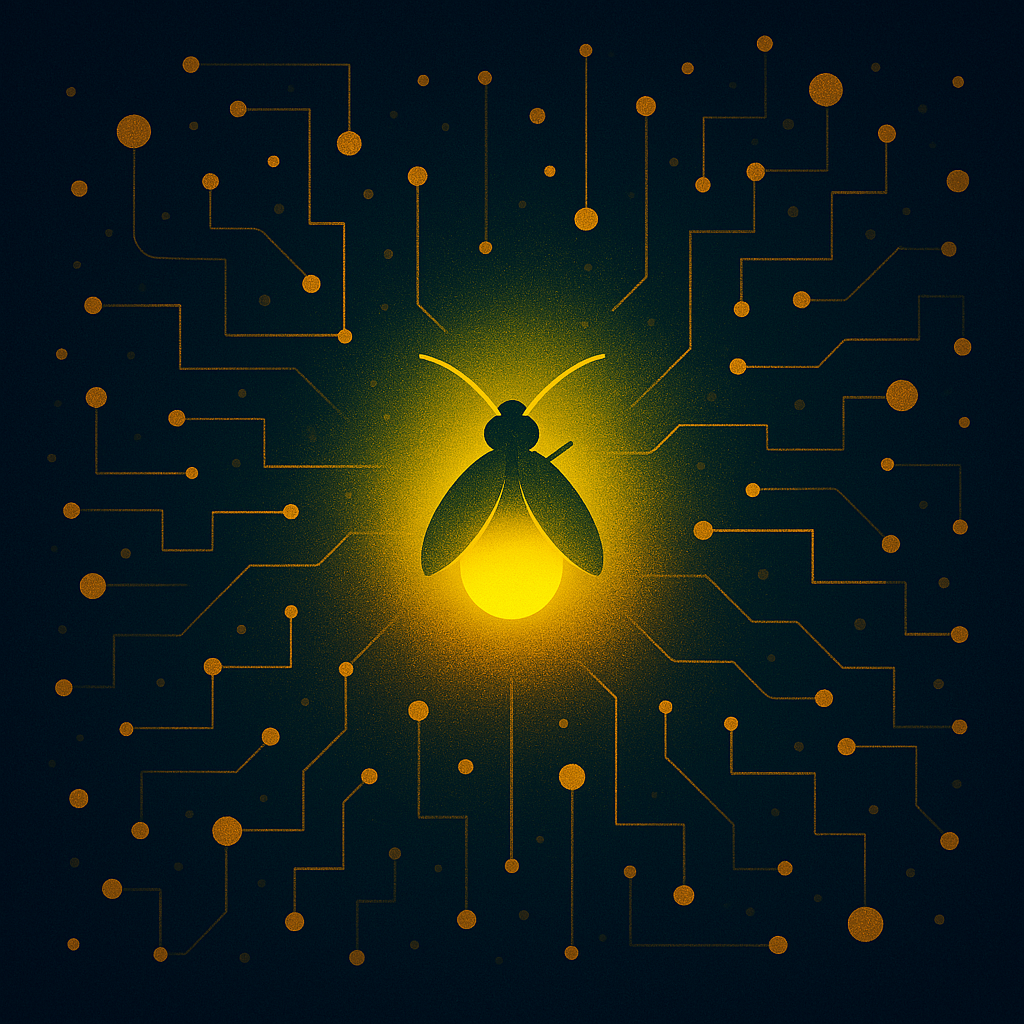
Observation as Bioluminescent Feedback
- Local signals ripple outward: A user query doesn’t just trigger a search—it shifts the semantic canopy. Like a firefly adjusting its rhythm to nearby pulses, the system’s internal state reorients in response.
- Emergent global patterns: Over time, fireflies sync up. Bespoke systems, too, begin to harmonize with user rhythms—not just reacting to prompts, but anticipating shifts in context with graceful attunement.
- Minimal disturbance, maximal resonance: The firefly doesn’t overwhelm. It glows briefly, offering a point of reference. In observability terms, this is lightweight telemetry—context-rich, non-invasive, and beautifully sufficient.
Spiral of Intent: Visualizing Observability as a Firefly Pulse
The spiral is one of nature’s most ancient forms of emergence. From galaxies to snail shells, it embodies growth, unfolding, and a journey that never quite loops back the same. In this visual sketch, we animate a firefly tracing a golden spiral—not bound by coordinates, but guided by inner rhythm.
import numpy as np
import matplotlib
matplotlib.use("TkAgg")  # Ensure compatibility when running as .py
import matplotlib.pyplot as plt
from matplotlib.animation import FuncAnimation

# Create spiral path
theta = np.linspace(0, 8 * np.pi, 500)
radius = np.exp(0.02 * theta)
x_data = radius * np.cos(theta)
y_data = radius * np.sin(theta)

# Set up figure
fig = plt.figure(figsize=(6, 6), facecolor="black")
ax = fig.add_subplot(1, 1, 1, facecolor="black")  # Ensure both fig and ax are dark

ax.axis("off")
ax.set_xlim(-120, 120)
ax.set_ylim(-120, 120)

# Firefly and trail
firefly, = ax.plot([], [], 'o', color='gold', markersize=10)
trail, = ax.plot([], [], color='lightyellow', linewidth=0.8, alpha=0.5)

def init():
    firefly.set_data([], [])
    trail.set_data([], [])
    return firefly, trail

def animate(i):
    if i < len(x_data):
        firefly.set_data([x_data[i]], [y_data[i]])
        trail.set_data(x_data[:i], y_data[:i])
        firefly.set_alpha(0.5 + 0.4 * np.sin(i / 10))
    return firefly, trail

ani = FuncAnimation(
    fig, animate, init_func=init, frames=len(x_data),
    interval=30, blit=True, repeat=False
)

ani.save("firefly_spiral.gif", writer="pillow", fps=30)

plt.show()
Each pulse is a moment of self-expression—and a disturbance in perception. The firefly glows not to be seen, but to participate. The path it leaves behind is a record of relational observability: subtle, continuous, attuned.
The transparency of the spiral, the soft fading trail, and the golden glow together evoke how bespoke AI systems might evolve: not through brute force observation, but through luminous presence—observing just enough to sync, not to surveil.
Ethical Implications in the Flicker
A firefly never demands attention—it simply offers presence. Bespoke observability, too, must be ethical in presence. What we illuminate, and how softly we glow, determines what the system reflects back.
When a system watches like a firefly—gentle, reciprocal, precise in its pulse—trust blooms.

 seemanair.com
Leave a comment