


Every decade promises the same thing. Software will become simpler.
We built programming languages to escape assembly. Cloud to escape managing servers. Kubernetes to escape deployment. AI to escape implementation.
Yet engineering never seems to get easier.
Instead, every breakthrough seems to uncover an entirely new class of difficult problems.
Why does complexity always return?
Perhaps it doesn’t.
A Different Pattern Emerges
Cloud was supposed to end infrastructure work. It ended racking servers and revealed the problem that only became visible once server management faded into the background: operating infrastructure at scale.
Kubernetes was supposed to end deployment complexity. It ended manual deployment and revealed the problem waiting underneath: coordinating distributed workloads.
Microservices were supposed to end monolith sprawl. They ended tangled codebases and revealed the network itself as the next constraint, who owns which fact, what happens when a call times out.
AI agents are supposed to end implementation work. They are ending manual coding and revealing what may be the next constraint: orchestrating autonomous decisions.
Each of these felt, at the time, like a new problem the technology had created. The tools were new. The underlying constraints weren’t, they were simply waiting for us to reach them. The disciplines we later built to name them cloud architecture, platform engineering, distributed systems came afterward, as responses. The problems came first.
What Becomes Invisible
An abstraction doesn’t remove complexity. It changes what’s visible.
Cloud didn’t eliminate infrastructure complexity. It made racking servers invisible, so the complexity underneath capacity planning, latency budgets, vendor architecture could finally come into focus.
Kubernetes didn’t eliminate deployment complexity. It made manual deployment invisible, so the complexity of orchestration itself service meshes, cluster health, the on-call rotation for the platform could come into focus.
Microservices didn’t eliminate monolith complexity. They made tangled codebases invisible, so the complexity of the network could come into focus.
In each case, the abstraction solved the visible problem. In doing so, it exposed a deeper one.
This is the part that’s easy to miss: the new layer feels invented. It rarely is. It was always part of the system; it just had no room to be seen until the layer in front of it stopped demanding all of our attention.
Nature Runs the Same Pattern
Ecological succession works the same way, and it’s a good place to check the idea against something that isn’t software.
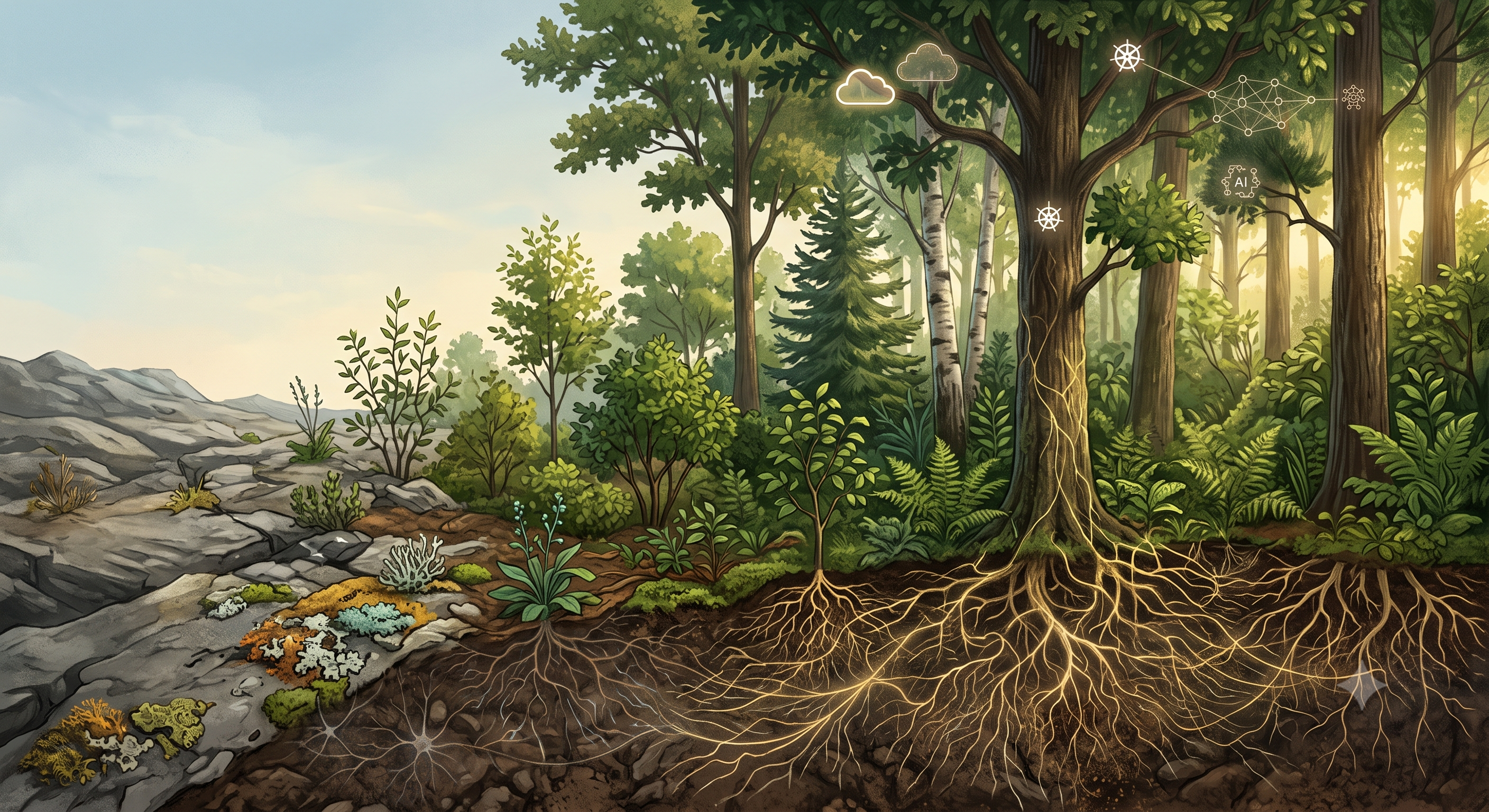
When a forest clearing opens, the first organisms to arrive aren’t complex. Lichens and pioneer grasses colonize bare rock, tolerating conditions nothing else could survive. In doing so, they simplify the environment literally building soil, moderating temperature and moisture.
That simplification isn’t the end state. It’s what makes the next layer visible. Shrubs arrive. Then fast-growing trees. Then, over decades, the shade-tolerant hardwoods that could never have survived the original bare ground. Below the surface, mycorrhizal fungi begin networking tree roots together, trading carbon and nutrients across species.
The forest doesn’t get simpler as it matures. It gets more interdependent. The mature forest has far more species interactions, more nutrient pathways, more relationships than the clearing ever did and none of that complexity was created by the lichen. The lichen simply cleared enough ground for it to become visible.
Software is following the same pattern, just on a much faster clock.
Where AI Fits
Right now, AI agents are acting like pioneer species. They’re absorbing the harshest, most labor-intensive layer of software work boilerplate, glue code, first-draft implementation, the way lichen absorbs bare rock.
That absorption is real progress. It’s also not the end state.
What it’s clearing space for is the layer that was always underneath implementation, just never visible because implementation consumed all the attention: which agent owns which decision, how disagreement between agents gets resolved, who is accountable when a system acts on incomplete information. These aren’t problems AI invented. They’re the layer implementation was always standing in front of.
Pioneer species don’t build the final ecosystem. They prepare the conditions for it.
AI may be doing the same thing. We think we’re watching the end of software engineering. We may actually be watching the beginning of a deeper layer, one where implementation fades into the background and coordination becomes the new frontier.
Closing
Complexity didn’t return. We simply reached a depth where we could finally see what had been there all along. Progress isn’t the disappearance of complexity. It’s the discovery of a deeper layer.
Every breakthrough doesn’t bring us closer to the end of complexity. It simply gives us the tools to explore a little further. Every abstraction doesn’t just change our tools. It changes what deserves our attention. And that may be the deepest measure of progress, not that the world becomes simpler, but that we’re finally free to notice the layer that was there all along.



Leave a comment