

Every year, on Independence Day, we remember the people who fought for India’s freedom, their courage, their sacrifices, their convictions. We remember the names that have become part of our history, and the countless others whose names we will never know. But as India marks its 80th Independence Day, I find myself thinking about something slightly different: what exactly did we inherit from them? Was it simply a free country, or was it something larger, an idea of what India could become?
I am not a historian or a political commentator. I am simply an Indian who feels deeply grateful for the freedom we inherited, and for the people who had the courage to imagine a different future for this country. Perhaps that is what Independence Day means to me, not just remembering how freedom was won, but remembering what that freedom was meant to make possible.
It is easy to think of independence as a single moment in history: 15 August 1947, a date, a flag, a new nation. But freedom is rarely only about who governs a country. It is about giving people the possibility to shape their own future, the freedom to learn, to think, to question, to speak, to worship or not, to build, to dream, to disagree, to participate, to live with dignity. Most of all, it is the freedom to live in a society where a person’s worth isn’t decided by the circumstances of their birth. That was a remarkably ambitious idea for a country as vast, diverse and unequal as India was, and in many ways still is. We were not simply trying to become independent. We were trying to become a nation.
The people who fought for that independence did not all agree with one another. They came from different regions, philosophies and traditions, and imagined India’s future in different ways. But running through that diversity was a shared and remarkable conviction: that India could become something better than what it had been. They fought against exploitation. They fought for dignity, for education, for the simple idea that opportunity shouldn’t depend on who your parents were. Many of them championed social reform and scientific progress at a time when such ideas were far from universally accepted. Many of them understood that freedom would mean very little if it simply replaced one form of power with another.
What inspires me most, though, is not simply that they wanted a free India. It is that many of them understood freedom could not be meaningful if it belonged only to the powerful. The India they imagined had to make room for people who had been marginalized, exploited or denied a voice. Their idea of freedom carried a responsibility with it, that dignity should not depend on power, and that justice should not be reserved only for those who could demand it.
That is what I find most inspiring about that generation. They were not only asking who should rule India. They were asking what kind of India was worth building. That question did not end in 1947. It became our inheritance, and our responsibility.
When we inherit something precious, we don’t usually think of ourselves as its owners so much as its caretakers, the way we think about a family home, a piece of land, a language, a river, a forest, a story passed down. India is all of these things and more: a civilization thousands of years old, and, at the same time, a young republic entrusted with the extraordinary task of holding enormous diversity together within a democracy. We inherited mountains and rivers, cities and villages, languages and literature, art and science and philosophy carried across centuries, and institutions built by people who believed this whole experiment was worth attempting. The real question was never whether this inheritance belongs to us. It is whether we are worthy custodians of it.
I sometimes think patriotism is portrayed as something grand, the flag, the anthem, the parade, the soldier standing at the border, and these things do matter. But I’ve come to believe patriotism also lives in much quieter places: in refusing a bribe even when no one would know, in treating the person who cleans our home or drives us or serves our food with the same basic dignity we expect for ourselves, in standing up when someone weaker is being exploited, in teaching a child that disagreement doesn’t require hatred, in protecting a tree because it’s worth isn’t only the shade it gives, in treating animals with compassion, in not wasting what we can easily afford to waste, in leaving a public space a little cleaner than we found it, in doing honest work when cutting corners would be easier. None of this will make it into a parade. But I suspect a country is ultimately built from millions of such small, unwitnessed choices.
The India of 1947 could scarcely have imagined the India of 2026, a country of satellites and smartphones, digital payments and artificial intelligence, world-class research and extraordinary entrepreneurial energy, connected to itself in ways our grandparents never could have dreamed of. But progress was never only about how much we possess. It is also about what we choose to do with it. Can we grow more prosperous without growing more indifferent? Can we become more powerful and stay just as compassionate? These don’t feel like political questions to me. They feel like human ones, the kind a free society should always feel comfortable asking itself.
There is something almost impossible about comparing our lives to those of the people who fought for this freedom. They endured imprisonment; they gave up careers, comfort, and sometimes their lives. Most of us will never be asked to sacrifice anything close to that. And perhaps we don’t need to be, because our generation was handed a different task: deciding what to do with the freedom they fought so hard to give us. We can use it to become more educated or more indifferent, more compassionate or more cynical, more curious or less so. We can use it simply to consume, or we can use it to build, to leave behind a country with not just more wealth but more humanity, not just more connectivity but more connection.
Eight decades is a long time for a person. For a nation, it is barely a beginning. India is still evolving, still arguing, still experimenting, still occasionally surprising itself, and that, too, is something worth celebrating, because independence never promised us perfection. It gave us the chance to keep trying. That may be the greatest part of what we inherited: the freedom to imagine a better India, the freedom to work toward it, and the freedom to begin again whenever we fall short.
When I think of the people who fought for this country’s independence, I don’t want to remember only their sacrifice. I want to remember their conviction, their belief that a different future was possible, their refusal to accept that exploitation was inevitable, their faith that education, reason, courage and human dignity could genuinely change a society. I hope we never lose that spirit, because independence was never something that happened once, nearly eight decades ago. It is something every generation inherits, and every generation must decide, for itself, what to do with.
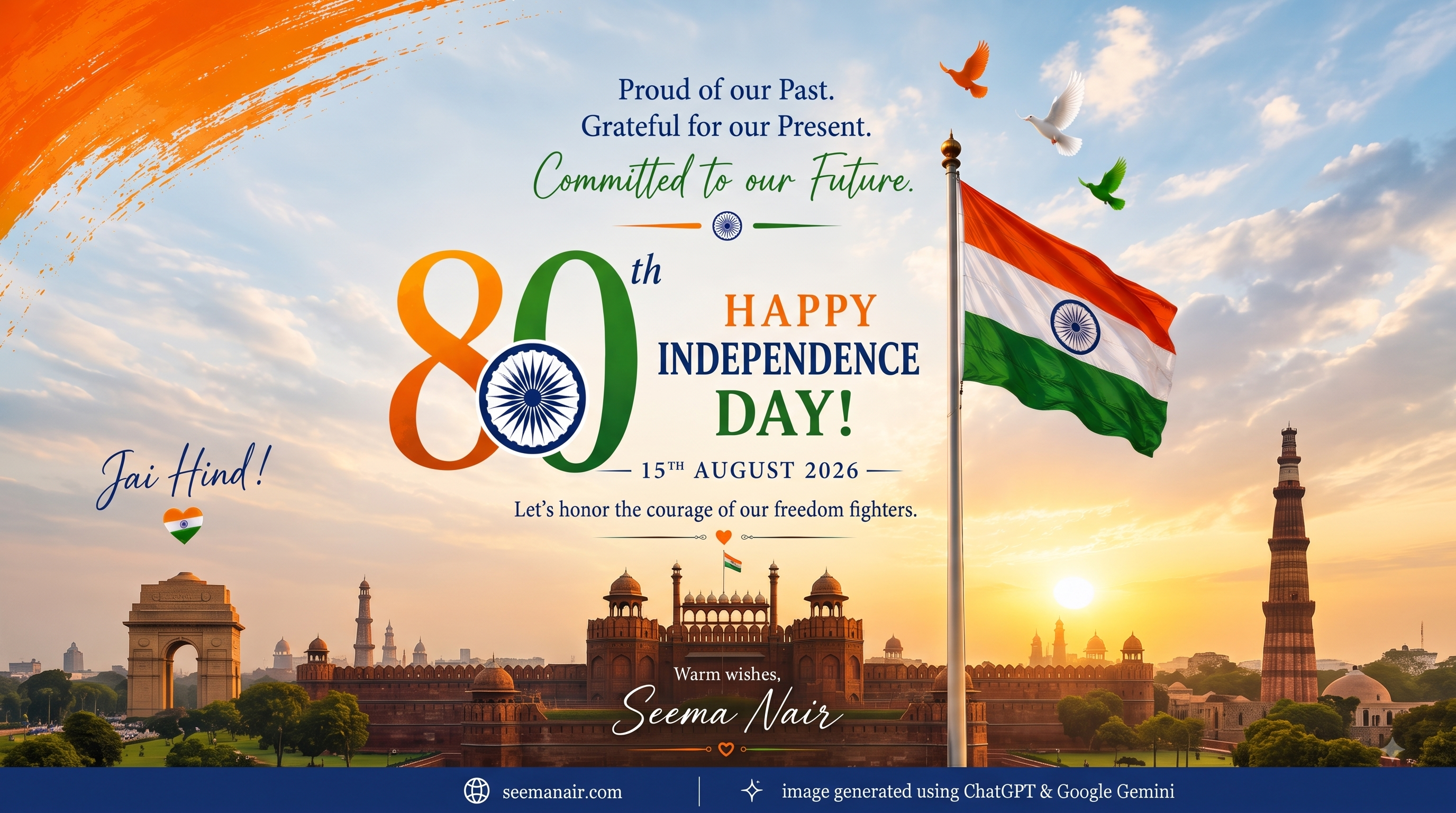
Happy 80th Independence Day, India!
May we always have the courage to protect the freedom we inherited, the wisdom to use it well, and the imagination to leave behind a country worthy of everyone who made it possible.
Jai Hind!




Leave a comment