


What if systems are less different than the things they contain?
A software engineer stares at a cascading outage. Services that were supposed to be independent have dragged one another down. She realizes the failure pattern is not unique to distributed systems. The same pattern appears when a government department tries to coordinate local offices that no longer share the same priorities or information.
A biologist studies homeostasis and suddenly sees the same corrective loops in markets and public opinion. An organizational designer notices that the architecture of a product almost perfectly mirrors the communication structure of the team that built it. An economist watches people optimize a metric until the metric stops measuring anything useful and recognizes the same dynamic in status games and institutional targets.
We tend to treat these observations as clever metaphors. We say a government “has a feedback problem” the way a thermostat does, or that an organization “suffers from technical debt.” But what if these are not metaphors at all? What if software systems, ecosystems, governments, corporations, and cultures are all subject to the same underlying constraints—constraints that do not care what the system is made of?
A software system, an ecosystem, a government, a corporation, and a culture have radically different components. Once we stop looking at what they are made of and start looking at how they behave, strange similarities emerge. Some of the principles that follow are formal laws. Others are observations, recurring patterns, or broader systems concepts. What they share is not identical mathematical status, but something more useful: they keep showing up across domains that supposedly have nothing in common.
The rest of this article explores those similarities through three lenses: the physics of politics, the biology of bureaucracy, and the code of culture.
Part I — The Physics of Politics
Politics is often discussed in the language of ideology, power, and personality. Yet many of its deepest problems look more like problems of force, constraint, variety, and equilibrium.
Ashby’s Law of Requisite Variety states that only variety can absorb variety. A system that wants to regulate another system must possess at least as much variety of possible responses as the disturbances it faces. If the environment can generate more kinds of disruption than the controller can answer, control fails. This is not a preference. It is a structural limit.
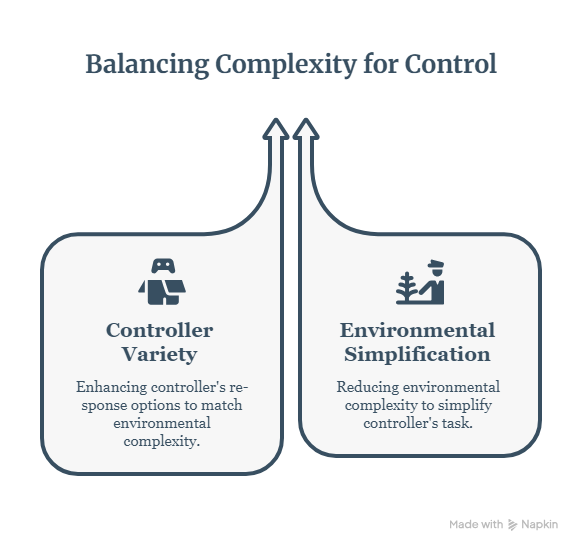
The practical implication is that a controller has two broad options: increase its own response variety, or reduce the variety of the environment it must deal with. Highly centralized authority facing a large, diverse population confronts this constraint directly. Expanding its own variety through more detailed administration, more sensors, or more differentiated responses is one path. Simplifying or standardizing the environment is another. Different systems make different choices, and each choice carries costs. The same constraint appears in software. Observability and control systems succeed only when the variety of signals and responses roughly matches the possible states of the system. A monitoring dashboard that tracks only a handful of metrics will miss novel failure modes. The immune system works because it maintains enormous response variety against an open-ended set of pathogens. In each case the principle is the same: the controller must match the complexity of what it faces, or the system drifts out of control.
Feedback loops determine whether a system stabilizes or runs away. Negative feedback detects deviation and counters it. Positive feedback amplifies deviation. Healthy systems rely heavily on negative feedback while carefully limiting positive feedback, so it does not explode. Delayed, distorted, or suppressed feedback is one of the most reliable ways any system fails.
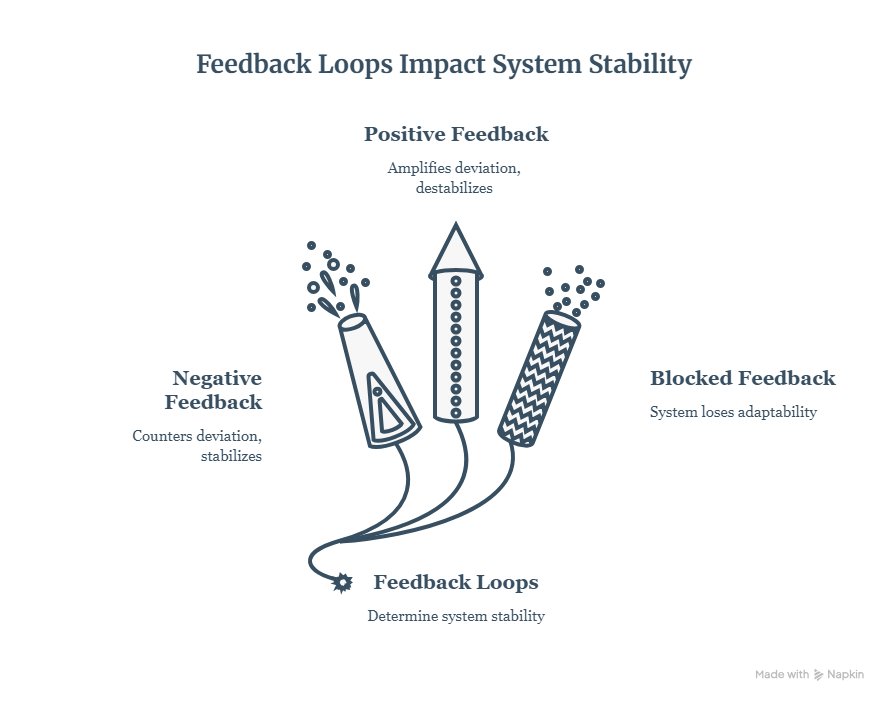
In politics the feedback channels include elections, markets, public opinion, protests, media, and informal reputation. When these channels are open and reasonably accurate, errors can be corrected before they compound. When they are blocked, delayed, or captured, the system loses its ability to adapt. The correction, when it finally arrives, is often abrupt and destructive. The same dynamic appears in software through monitoring, alerting, continuous integration, and user telemetry. A system that cannot see its own errors cannot correct them. In biology the equivalent is homeostasis and the continuous adjustment of physiological variables. Feedback is not a metaphor borrowed from engineering. It is a fundamental requirement for any system that must remain viable in a changing environment.
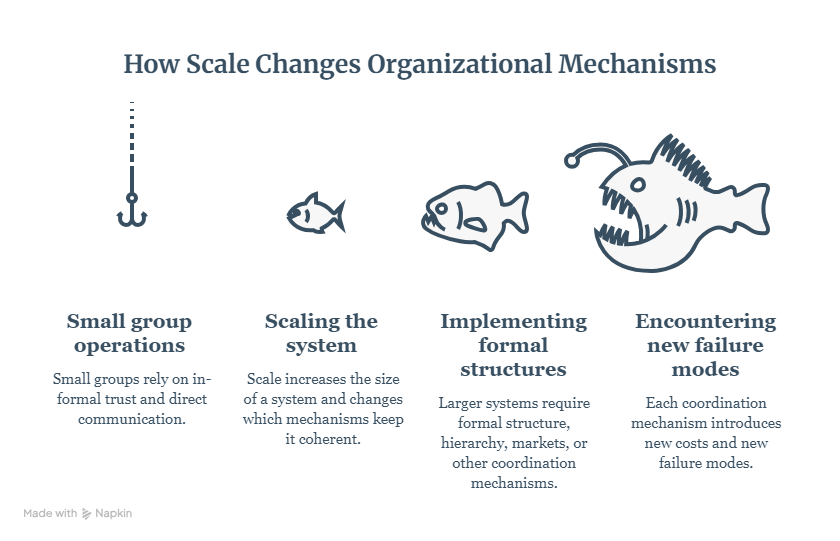
Scale changes the rules. What works at one size often fails at another. Small groups can rely on informal trust and direct communication. Larger systems require formal structure, hierarchy, markets, or other coordination mechanisms, each of which introduces new costs and new failure modes. Scale does not merely increase the size of a system; it changes which mechanisms can keep it coherent. This is why the same organizational form that thrives in a startup can become dysfunctional in a large institution, and why political systems that function at the scale of a city-state struggle when stretched across continents.
Related to both variety and scale is the recurring problem of local optimization. When every part of a system optimizes its own objectives, the whole can still lose.
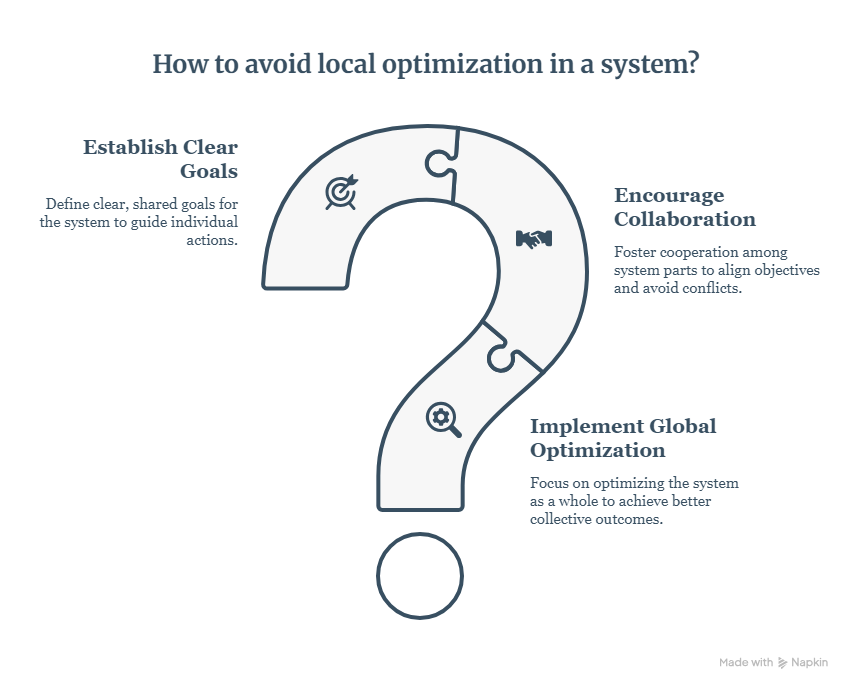
Ministries, agencies, parties, corporations, and interest groups can each succeed on their own metrics while producing a collective outcome that is worse for everyone. The system is not the sum of its optimized parts.
Part II — The Biology of Bureaucracy
Bureaucracy is usually criticized as mere inefficiency or administrative excess. A more useful frame is to treat organizations and institutions as living (or at least evolving) systems that must maintain order against continuous decay and must adapt or become obsolete.
Entropy points to a deeper requirement: order is temporary and expensive. In physics, the second law of thermodynamics tells us that in a closed system entropy increases unless energy is continuously supplied to maintain or create order. This is not to say that technical debt or institutional decay is literally thermodynamic entropy. The connection is structural rather than physical: maintaining organized states requires continual input and work. Left alone, systems drift toward disorder. Processes accumulate. Approvals multiply. Documentation becomes obsolete. Exceptions harden into permanent rules. The original purpose of a control is forgotten. Nobody remembers why a particular form or committee exists, only that removing it feels risky.
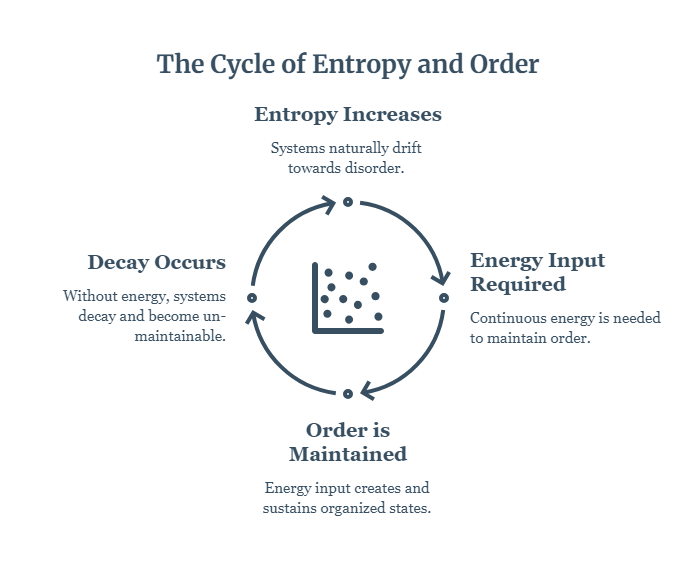
Software engineers know this as technical debt, bit rot, and dependency decay. Without continuous energy in the form of refactoring, testing, and simplification, a codebase drifts toward un-maintainability. Ecosystems require constant energy flow to sustain low-entropy organization. Institutions require the same continuous investment. Decay is the default.
Gall’s Law observes that a complex system that works is invariably found to have evolved from a simple system that worked. A complex system designed from scratch never works and cannot be patched up to make it work. You have to start over with a working simple system.
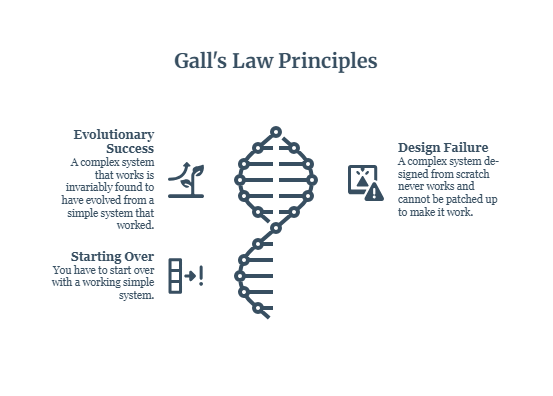
Bureaucracy is an almost perfect illustration. No one sits down one morning and designs a seventeen-step approval process. The process grows through decades of small additions: one more control after a failure, one more committee after a scandal, one more reporting requirement after an audit, one more exception for a special case. Each addition is locally rational. Over time the system becomes almost impossible to simplify because every piece has acquired a constituency and a justification. The same pattern appears in software architectures that begin clean and accrete complexity until no one dares to change the foundation, and in biological systems that evolve incremental adaptations rather than being redesigned from first principles.
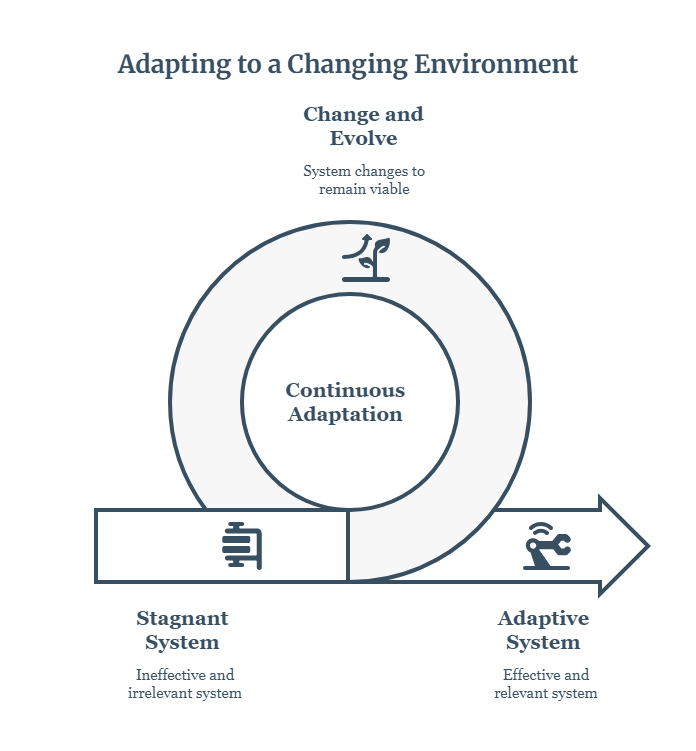
Lehman’s insight about evolving systems is equally transferable. A system that lives in a changing environment must be continually adapted or it becomes progressively less satisfactory. Complexity increases unless explicit work is done to reduce it. An organization perfectly suited to the conditions of 1985 can become dysfunctional in 2026 without anyone deliberately making it so. The environment changed-technology, expectations, scale, competition—while the internal structure lagged. The same pattern appears in software systems that must evolve or lose relevance, and in biological populations that fail to adapt to new selective pressures. Stasis is not a neutral state. In a changing world it is a form of decline.
Part III — The Code of Culture
Culture is often treated as something soft and ineffable. Yet cultures also run on information, proxies, and encoded structure. The principles that govern measurement, architecture, and collective behavior reappear here with particular force.
Goodhart’s Law states that when a measure becomes a target, it ceases to be a good measure. Once people know they are being evaluated on a particular metric, they optimize the metric itself rather than the underlying goal the metric was meant to approximate. The correlation breaks under pressure.

This is not merely an organizational pathology. Culture itself generates proxies: status symbols, credentials, titles, visible busyness, social approval signals, and institutional KPIs. Once the proxy becomes the objective, people optimize the proxy. Students optimize grades rather than learning. Professionals optimize credentials rather than competence. Organizations optimize the dashboard rather than the outcome the dashboard was supposed to track. The same dynamic appears when software teams are measured on story points or lines of code, or when factories are measured on tonnage of output. In each case the proxy is gamed until it no longer points at the thing that mattered. Culture, in this light, is a distributed system executing optimization code on human behavior.
Conway’s Law, originally observed in software, states that organizations design systems that mirror their own communication structure. The insight generalizes. Systems encode the interaction patterns of the people who create them. Software does this. Organizations do this. Institutions do this. Even cultural artifacts carry the imprint of the communication structure that produced them.
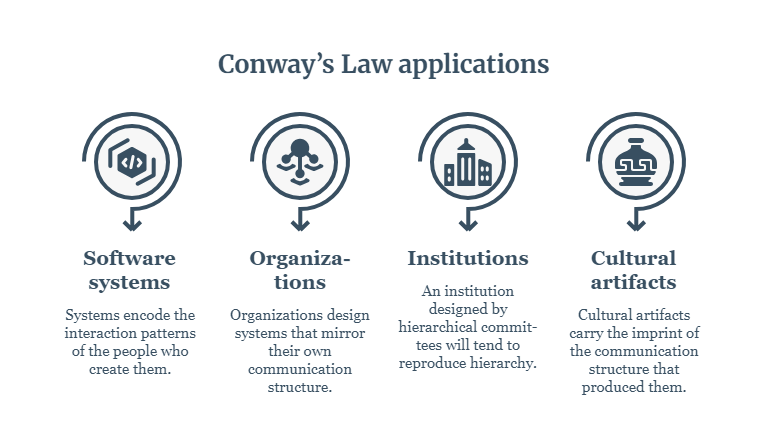
The things we build become fossilized representations of how we talked to one another while building them. A product architecture that mirrors siloed teams will struggle with integration. An institution designed by hierarchical committees will tend to reproduce hierarchy. The structure of the creators becomes the structure of the creation.
Emergence is the final and most unsettling principle. Complex systems exhibit behavior that cannot be reliably inferred from the behavior of their parts in isolation. The whole behaves in ways no individual intended or could have fully predicted.
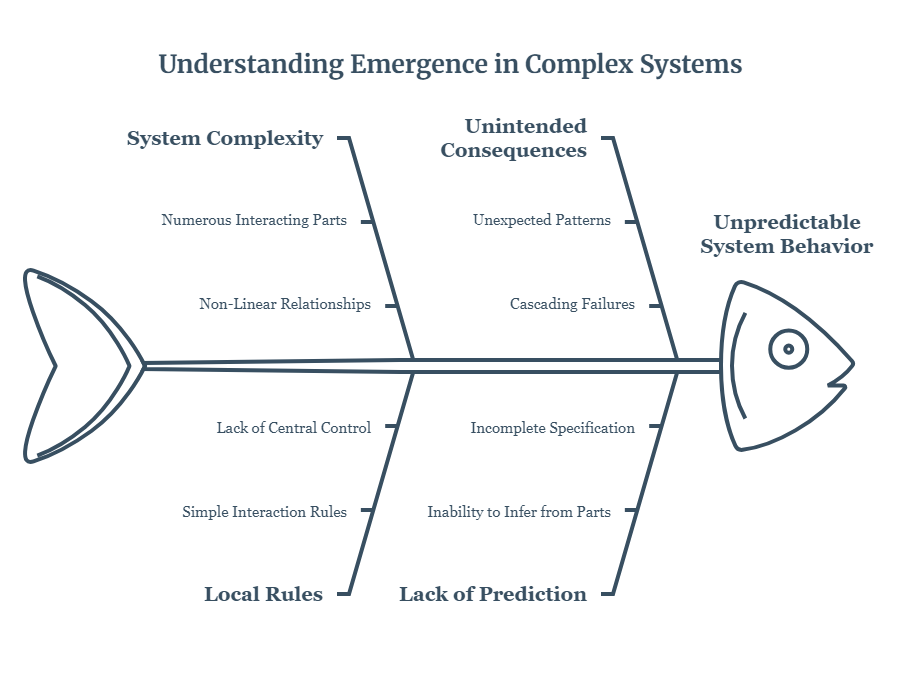
Nobody designs a culture in the way an engineer designs a bridge. Nobody individually creates a market. Nobody programs a crowd. Nobody fully specifies the runtime behavior of a sufficiently large distributed software system. And yet coherent, often powerful patterns still appear—norms, prices, collective moods, cascading failures, unexpected robustness. Simple local rules and interactions produce global regularities that no single actor controls. This is both the source of systems’ power and the reason they so often surprise their creators.
Conclusion
Physics. Biology. Code. Different vocabularies for systems made of different materials—votes and incentives, cells and procedures, bits and status signals. Underneath them sit recurring constraints: variety and control, feedback, energy and maintenance, evolution from the simple, the corruption of proxies, the encoding of social structure, scale, trade-offs, and emergence.
We keep inventing new technologies, institutions, and organizational forms. We redesign governments, rewrite corporate structures, and build ever more elaborate software. But we do not get to invent the laws under which those systems operate.
The components change. The constraints do not.
That is the deeper claim. The similarities across domains are not just useful analogies. They are manifestations of the same underlying regularities. A feedback loop in a political system is not literally the same mechanism as a feedback loop in a thermostat or a biological organism. Yet the systems principle is real in each case. Once we see the constraints clearly, we stop being surprised by the same failures in different costumes—and we gain a more realistic sense of what kinds of systems can actually remain coherent over time.





Leave a Reply